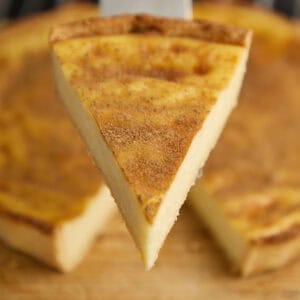
Baked Milk Tart (Gebakte Melktert)
Classic South African Baked milk tart(gebakte melk tert) in a delicate buttery short crust pastry.
Servings 8 slices
Ingredients
Pastry
- 250 grams all-purpose flour
- 32 grams powdered sugar
- 3 grams fine table salt
- 125 grams cold butter - diced into 2 cm cubes
- 50 grams egg - beaten and sieved
Custard
- 750 grams whole milk
- whole cinnamon stick
- 3 strips dried naartjie or tangerine peel
- ⅓ whole nutmeg - finely grated
- 67 grams white sugar
- 3 each large whole eggs
- 1 each large egg yolk
- 45 grams cornstarch
- 25 grams all-purpose flour
- 8 grams vanilla extract
- 3 grams fine table salt
- 30 grams unsalted butter
- Ground cinnamon, for dusting

Instructions
Pastry and tart shell
- Sift the flour and powdered sugar into a bowl and add the salt. Rub in the cold diced butter with your fingertips until it looks like coarse sand with a few small butter bits still visible. Work fast so the butter stays cold.
- Add the beaten, sieved egg and mix just until the dough starts to clump. Press it together on the bench without kneading, shape into a flat disc, wrap, and chill for at least 1 hour or overnight.
- Butter a 23 cm dish about 3 cm deep and chill it.
- Let the dough lose its fridge chill for a few minutes, then roll it to about 3 mm on a floured surface. If it tears, pinch it back together.
- Roll the pastry around the pin, unroll it over the dish, and ease it into the corners without stretching. Press it into the flutes, leave a small overhang above the rim for shrinkage, and trim. Chill the shell until firm. Preheat the oven to 170°C.
- Prick the base with a fork, line with parchment, and fill with a thin layer of rice or dried beans. Bake 12 minutes, remove the parchment and weights, then bake 6 more minutes until the base is golden and fully cooked.
Filling and baking
- Infuse the milk: warm the milk, cinnamon stick, naartjie peel, and grated nutmeg until it just starts to simmer. Off the heat, cover, and steep for at least 1 hour, overnight in the fridge is better.
- Whisk the sugar, whole eggs, yolk, cornstarch, flour, vanilla, and salt to a smooth, lump-free paste.
- Reheat the infusion to just below a simmer. Strain it onto the paste in a slow stream, whisking hard the whole time. Discard the cinnamon and peel.
- Pour everything back into the pan over medium-low heat. Whisk constantly to a full boil, thick, with big slow bubbles, then boil for about 10 seconds, still whisking.
- Off the heat, add the butter and blitz with a stick blender for 30 to 60 seconds until glossy and completely smooth.
- Sieve the custard into the baked shell and smooth the top roughly level. Raise the oven to 180°C.
- Bake about 25 minutes, rotating once for even color, until the surface sets into a skin and browns in patches.
- Cool in the dish on a wire rack to room temperature.
- Dust the cooled surface with ground cinnamon, generous but light, and slice into 8.
Video
Notes
- Naartjie peel — The naartjie is South Africa's small, loose-skinned tangerine. Use dried strips, and swap in tangerine, mandarin, or orange peel if you cannot get them. In season, dry your own strips on a rack for a few days.
- The boil — The 10-second full boil fully gelatinizes the cornstarch and flour so the custard holds its water through the second bake. Cut it short and the baked slices weep. Older recipes fold in whipped egg whites — the air insulates the custard and it bakes uneven and foamy, so this recipe uses whole eggs whisked straight in.
- Equipment — A 23 cm dish about 3 cm deep holds the roughly 1 liter of filling. Ceramic heats slowly, so give the blind bake its full time. Metal colors the base faster — check at 10 minutes. No stick blender: whisk the butter in hard off the heat and rely on the sieve.
- Doneness — Surface set into a skin, browned in patches, slight wobble in the center. The puffed top sinking into wrinkles as it cools is correct, not a fault.
- Common pitfalls and recovery — Grainy custard, egg threads: blitz hard and sieve. Torn pastry: pinch together or patch with scraps. Shrunken shell: fill what you have, the tart just bakes slightly shallower.
- Substitutions — Store-bought all-butter shortcrust, about 375 grams, works, blind baked the same way. Gluten-free: a GF blend for the pastry, and replace the 25 grams flour in the custard with about 12 grams extra cornstarch. Dairy-free: full-fat coconut milk one for one, plant butter in the pastry, skip the finishing butter.
- Storage and reheating — Covered in the fridge, 3 days. Serve cool or at room temperature, never reheated. Dust with cinnamon just before serving. Do not freeze the baked tart.
- Make-ahead — Dough and infusion the night before, shell blind baked in the morning, custard and final bake under an hour.
Nutrition
Serving: 150grams Calories: 403kcal Carbohydrates: 48g Protein: 8g Fat: 20g Saturated Fat: 12g Polyunsaturated Fat: 1g Monounsaturated Fat: 5g Trans Fat: 1g Cholesterol: 79mg Sodium: 438mg Potassium: 194mg Fiber: 1g Sugar: 17g Vitamin A: 675IU Vitamin C: 1mg Calcium: 130mg Iron: 2mg
Keywords:baked milk tart, gebakte melk tert
Did you make this?Tag @pantsdownapronson or hashtag #pantsdownapronson so I can see your hot skills!