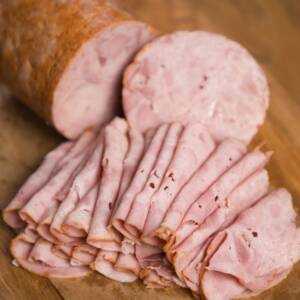
Homemade Turkey Deli Ham
Homemade turkey deli meat made the real way — a three-texture method that gives genuine sliceable cold-cut texture, not sliced roast turkey.
Servings 15 portions
Ingredients
For the turkey cubes
- 400 grams turkey meat - skinless and boneless thigh
- 4 grams salt
- 1 gram curing salt #1 - optional
- 6 grams msg - optional
For the turkey mince
- 350 grams turkey meat
- 4 grams salt
- 1 gram curing salt #1 - optional
- 40 grams water
- 2 msg msg - optional
For the turkey puree
- 250 grams turkey meat
- 20 grams water
- 2 grams garlic powder
- 4 grams salt
- 2 gram curing salt #1 - optional
- 6 grams msg - optional
- 30 grams egg white - from one large egg
Extra
- 2 grams smoked paprika

Instructions
Preparing the meat
- Trim the turkey if not trimmed already. Remove any tough tissue or bones. Cut it into roughly 2.5 centimetre or 1 inch cubes.
- Split the cubes into three separate parts. 400 grams, 350 grams and 250 grams. Each part is seasoned differently and creates a different texture in the ham. We keep 400 grams whole, 350 grams get minced and 250 grams gets puréed.
- Season each mix as listed in the ingredients.
- Process the purée through a food processor and the mince through a mincer or buy ready made mince. Keep the 400 gram part whole.
- Mix it all together in a bowl until well combined.
Shaping (See notes for alternative shaping methods)
- Lay down a double layer of plastic wrap and sprinkle it with paprika in the centre.
- Place the turkey mix onto the paprika and wet your hands with a bit of water to prevent sticking. Shape it into a log or sausage shape, removing any trapped air pockets as well as you can.
- Fold the wrap over, so the meat is encased inside. Make sure to overlap the plastic wrap, but don't get it caught up in the meat. Push the meat from side to side through the wrap to remove more trapped air.
- Next, grab the sides and while keeping contact with the surface you roll the log tight, so it firms up. The roll will get a bit thicker and shorter.
- Use a tooth pick or needle to prick holes where you see air bubbles. Repeat the rolling and tightening process once more before wrapping in another double layer of plastic.
- Roll the ham log tight and close off the ends by tying a knot each side.
Cooking (See notes for alternative cooking method)
- Turn your oven to 100 °C or 212 °F.
- Fill up a casserole dish or deep dish with boiling water.
- Place the turkey boloney log into it. Cover with a small piece of parchment and then with foil or a tight-fitting lid.
- Cook for about an hour, or until a thermometer placed in the thickest part (centre) reaches 68 °C or 154 °F.
- Once cooked, you remove it and cool it down in a bowl of ice water or any place cool until the internal temperature reaches 8 °C or 46 °F before either storing or slicing.
Video
Notes
1. Choosing the turkey — Skinless, boneless turkey thigh is the default for its richer flavor and slight fat content. Turkey breast works too and gives a leaner, paler result. Trim any tough tendons or sinew before cubing, or they end up as chewy threads in the finished log.
2. The three-texture method — The recipe splits the meat into whole cubes, coarse mince, and smooth purée on purpose. The whole cubes give bite, the mince binds, and the purée emulsifies the lot into a sliceable block. Keep the parts separate and process only the portion each step calls for — running everything through the food processor gives a rubbery, hot-dog texture.
3. Curing salt and color — Prague powder #1 (curing salt #1) is optional. It gives the familiar deli pink and protects against botulism if you cold-smoke. For an oven batch eaten within a few days it can be left out, in which case the meat cooks to a natural pale grey. If you want color without the nitrite, work extra smoked paprika into the mix to warm it up.
4. MSG — Optional but it adds the savory depth you expect from deli meat. A splash of soy sauce or a little grated Parmesan adds natural glutamates if you would rather skip the MSG itself.
5. Equipment — A meat grinder and food processor do the texture work; pre-made turkey mince is a workable shortcut if you lack a grinder. A temperature probe is the single most useful tool here — deli meat is cooked to a precise internal temperature, not by time. To release the cooked log from a ham press, use cooking spray rather than oil, or line the press with plastic wrap or a vacuum-sealer bag.
6. Other cooking methods — Sous vide at 70°C / 158°F for 2 hours is the most precise method. The oven method (100°C / 212°F in a water bath to an internal 68°C / 154°F) is the accessible alternative shown in the video. You can also cold-smoke the log after cooking — use the curing salt if you do.
7. Common pitfalls and recovery
- Log falls apart when sliced: too little purée or trapped air. Keep the three-texture ratio and work the air out — prick bubbles, roll tight twice.
- Rubbery or paste-like: too much purée or over-processing. Keep the three parts separate.
- Grey instead of pink: use the optional curing salt, or warm the color with extra smoked paprika.
Nutrition
Serving: 50g Calories: 77kcal Carbohydrates: 0.2g Protein: 15g Fat: 1g Saturated Fat: 0.3g Polyunsaturated Fat: 0.3g Monounsaturated Fat: 0.3g Trans Fat: 0.005g Cholesterol: 45mg Sodium: 496mg Potassium: 165mg Fiber: 0.1g Sugar: 0.1g Vitamin A: 86IU Vitamin C: 0.003mg Calcium: 8mg Iron: 1mg
Keywords:homemade cold cuts, homemade deli meat, turkey bologna, turkey deli ham, turkey lunch meat
Did you make this?Tag @pantsdownapronson or hashtag #pantsdownapronson so I can see your hot skills!