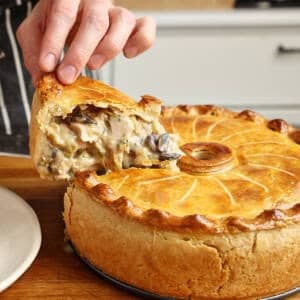
The Ultimate Chicken Pie (Video)
The best chicken pie I know how to make, and a proper weekend project. Roasted chicken, a stock reduced down to a ramen-style richness, a tarragon velouté, and buttery shortcrust top and bottom. Make the pastry and filling ahead and it comes together without cooking all day.
Servings 8 slices
Ingredients
For the shortcrust pastry
For the chicken and stock
- 2 (2) whole chickens - weighing about 2kg or 4,4 lbs each
- oil and salt - for roasting
- 250 grams (2 cups) carrot - washed, skin on
- 150 grams (1 cups) leeks - washed well
- 150 grams (1 ½ cups) celery
- 75 grams (5 tablespoon) 1 whole head garlic
- 6 each (6 each) dried bay leaves
- 10 grams (2 teaspoon) dried shiitake
- 10 grams (2 teaspoon) peppercorns
- 250 milliliters (1 cups) dry white wine
- water - to cover
For the mushroom and leek base
- 30 grams (2 tablespoon) olive oil - or rendered chicken fat
- 350 grams (4 ½ cups) chestnut mushrooms
- 150 grams (1 ½ cups) leeks - washed well
- 30 grams (2 tablespoon) 5 cloves garlic
- 4 grams (2 tablespoon) thyme leaves - freshly picked off the stalks
- 9 grams (1 ½ teaspoon) salt
- 30 grams (2 tablespoon) soy sauce
- 24 grams (½ cup) tarragon - chopped
For the velouté
- 50 grams (3 ½ tablespoon) butter
- 30 grams (2 tablespoon) rendered chicken fat
- 80 grams (⅔ cup) flour - all-purpose
- 600 milliliters (2 ½ cups) reduced chicken stock
- 120 grams (½ cup) heavy cream
- 30 grams (2 tablespoon) Dijon mustard
- 15 grams (1 tablespoon) nutritional yeast
- 9 grams (1 ½ teaspoon) tsp salt
For the egg wash
- 2 each (2 each) egg yolks - from large eggs
- 30 milliliters (2 tablespoon) cold water

Instructions
Make the pastry
- Whisk the eggs with the ice-cold water, pass through a sieve, and keep in the fridge.
- Sift the flour and salt into a bowl, add the cold butter, and rub it in until the mix is sandy but still shows small nuggets of butter. Those irregular pieces are what make the pastry flaky, so do not rub it to a uniform powder.
- Mix in the chilled egg with a fork until it just starts to come together and is still crumbly. Do not overwork it.
- Tip onto a surface and press together without kneading. Wrap and chill at least 1 hour, ideally overnight.
Roast the chicken and make the stock
- Break down both chickens. Put 4 legs and 2 breasts on one tray for the pie and reserve the other 2 breasts for another use. Put the bones, skin, and wings on a second tray.
- Rub the legs and breasts with oil and salt and roast at 230°C (445°F) for about 20 minutes, pulling the breasts at 69°C (156°F) and the legs at 74°C (165°F). Save every drop of the juices and move the skins onto the bone tray.
- Roast the bone tray until deep amber brown. Pour off and reserve the rendered fat.
- Deglaze the bone tray with the white wine, scraping up all the fond.
- In a large pot, sweat the carrot, leeks, celery, and garlic in a little rendered fat with no salt. Add the shiitake, bay, and peppercorns, then the roasted bones, the deglazing liquid, and the saved juices. Cover with just enough water.
- Bring to a steady simmer, skim, and reduce by half to a concentrated, full-bodied stock. Do not salt it. Strain and measure out 600 ml for the velouté.
Make the filling
- Pick the roasted meat, tearing the breast roughly and running a knife through it so there are no stringy pieces. Keep it chunky. Add the picked bones to the simmering stock.
- Brown the mushrooms hard in the oil or rendered fat with no salt, stirring for even color. Add the leek, crushed garlic, thyme, and salt and cook until soft. Add the soy and a splash of stock and simmer until the liquid has evaporated.
- Fold the mushroom and leek base through the picked chicken.
Make the velouté and finish
- Melt the butter and rendered fat, add the flour, and cook to a light blonde roux.
- Ladle in the 600 ml reduced stock bit by bit, whisking smooth after each addition. Off the heat, whisk in the cream, Dijon, nutritional yeast, and salt.
- Fold the velouté through the chicken and mushrooms, then stir in the chopped tarragon.
- Cool the filling completely until thick and set. Never fill the pastry warm. This is best made a day ahead.
Assemble and bake
- Let the pastry sit until about 13°C (55°F), then roll it to 4 mm thick. Butter a 23 cm (9 in) springform generously. Cut a base larger than the tin and a lid slightly larger than the top.
- Line the tin with the base, pushing it into the walls with no trapped air, leaving a 1.5 cm overhang. Chill 10 minutes, and chill the lid too.
- Spoon in the cold filling, leaving 2 cm clear at the top. Lay on the lid and press the edges together to seal.
- Whisk the egg yolks with the water for the wash. Brush the lid thinly, crimp the edges, and cut a central steam vent. Chill 10 minutes, then egg-wash once more.
- Bake at 200°C (390°F) fan for 40 to 45 minutes, rotating halfway, until deep golden. Rest 15 to 20 minutes, then release the springform and cut a big slice.
Video
Notes
- This is a project, so spread it out — You do not have to cook all day. Make the stock and roast the chicken on day one, the filling on day two, and assemble and bake on day three. The filling actually tastes better after a night in the fridge, and the pastry is happy wrapped up for a couple of days.
- Quick version — Use boneless chicken thighs, store-bought chicken stock, and store-bought pie pastry.
- Turn it into a chicken pot pie — Use a pie dish and simply cover the top with a pastry lid. Egg wash and bake until golden brown.
- Cold is the whole game for the pastry — Cold butter, cold egg, ice water, cold hands, cold bench. Warm butter melts into the flour, and you get greasy, tough pastry instead of flaky and short. If anything starts to feel soft or greasy at any point, stop and put it in the freezer for five minutes.
- Do not overwork the dough — Rub the butter in until the mix is sandy but still shows little nuggets of butter, and stop mixing the moment it comes together. Press it into shape, do not knead it. Working it builds gluten, which makes the pastry shrink and turn chewy.
- The single most important step is a cold filling — This is what separates a crisp pie from a soggy one. A warm or loose filling steams the bottom crust before the oven can set it. Cool the filling completely until it is thick enough to hold its shape on a spoon. If you remember one thing, remember this.
- No blind bake needed — Because the filling goes in cold and thick and the oven is hot, the base sets before the inside can turn it soggy, so you can skip the blind bake other pie recipes call for.
- What "reduce by half" means, and why no salt — You are boiling the stock down until there is half as much liquid, which concentrates it into something closer to a ramen broth than a thin stock. Do not salt it while it reduces or it will end up too salty once concentrated. All the salt goes into the filling and velouté later, where you can taste as you go. This takes roughly an hour to an hour and a half on a steady simmer, depending on your pot and heat.
- Brown the mushrooms hard, salt them late — Get them deeply browned over high heat with no salt. Salt pulls their water out and they steam pale instead of caramelizing, which is where a lot of the savory flavor lives. The salt goes in once they are browned.
- Watch the chicken temperatures — Pull the breasts at 69°C (156°F) so they stay juicy and the legs at 74°C (165°F). The breast keeps cooking inside the pie, so taking it out early is what keeps it from drying. A probe thermometer takes the guesswork out.
- For the crispest bottom, bake it low — Put the springform straight on a low oven rack, or even the oven floor for the first ten minutes. Do not sit it on a baking tray, as the tray slows the heat reaching the base. A metal springform conducts heat better than a ceramic dish.
- Use a springform if you can — Releasing the walls lets you serve a fully pastry-wrapped pie with crisp sides instead of a pie stuck in a dish. A regular 23 cm (9 in) pie dish works too, you just lose the exposed pastry wall.
- Rest before you cut — Give the baked pie 15 to 20 minutes out of the oven before slicing so the filling settles. Cut it too soon and it runs everywhere. It is meant to be a little messy, but a short rest helps the first slice hold.
- Use up the spares — You only use 2 of the 4 breasts, so save the other two for another meal. Keep the rendered chicken fat too. It lasts weeks in the fridge and is gold for roast potatoes or starting your next pot of vegetables.
- No tarragon? — It is what makes this pie memorable, so it is worth tracking down. If you truly cannot find it, use flat-leaf parsley stirred in at the end. You lose the gentle anise note, so use a little more than you think.
- Make-ahead and storage — Stock and roast: up to 3 days ahead. Filling: 1 to 2 days ahead, and it improves overnight. Pastry: 2 days in the fridge or a month in the freezer. Freeze the assembled unbaked pie up to 3 months and bake from frozen at 190°C (375°F), adding 15 to 20 minutes. Baked pie keeps 3 days covered, reheated at 180°C (350°F) for about 15 minutes so the crust re-crisps.
Nutrition
Serving: 300grams Calories: 954kcal Carbohydrates: 48g Protein: 44g Fat: 65g Saturated Fat: 28g Polyunsaturated Fat: 9g Monounsaturated Fat: 22g Trans Fat: 1g Cholesterol: 251mg Sodium: 1611mg Potassium: 924mg Fiber: 3g Sugar: 3g Vitamin A: 3072IU Vitamin C: 10mg Calcium: 117mg Iron: 7mg
Keywords:British chicken pie, chicken pie
Did you make this?Tag @pantsdownapronson or hashtag #pantsdownapronson so I can see your hot skills!