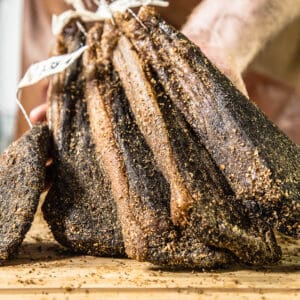
Ultimate South African Biltong Recipe
Watch the video below. Biltong is a traditional South African cured meat. It's easy to make, takes much less time than other cured meats and is the perfect snack any time of the day. Tip: Set the servings to the weight of your meat in grams and the whole recipe scales with it.
Servings 2000 grams meat
Ingredients
For the meat
- 2000 grams (4 ⅖ lb) top rump - or topside with plenty of fat
- 120 grams (⅖ cups) coarse sea salt
Wet cure
- 120 grams (½ cups) red wine vinegar
- 120 grams (½ cups) Worcestershire sauce
- 60 grams (¼ cups) honey
Spice mix
- 40 grams (½ cups) coriander seeds
- 20 grams (⅕ cups) fennel seeds
- 4 grams (1 tablespoon) chilli flakes
- 10 grams (1 tablespoon) black peppercorns
Optional
- 6 grams (1 teaspoon) baking soda - optional

Instructions
Prepping and salting the meat
- Cut the meat into 3cm or 1,1-inch strips along the grain of the meat. Trim off silver skin, connective tissue or any unwanted fat but I suggest you leave the fat on for moisture and flavour.
- Sprinkle the salt all over the meat including the sides.
- Let it sit for 3 hours in the salt flipping a few times to ensure even salting.
Wet curing
- While the meat is salting mix together all the wet cure ingredients.
- Once the meat has salted for 3 hours, rub off the salt but don't wash it.
- Place the meat and the cure in a fitting non-reactive food-safe plastic or ceramic container.
- Let it marinate for 2 hours turning the meat a few times to ensure even marination.
Spicing
- While the meat is marinating, toast the coriander seeds, fennel seeds and chilli flakes in a dry pan on medium heat. Do this in a well-ventilated kitchen.
- As soon as the spices are nicely toasted, slightly smoky and fragrant, remove them from the pan and let them cool down completely.
- Once cooled, blitz the spices in a spice grinder or pestle and mortar until nicely broken up but not too fine. You want to be able to identify the different spices.
Optional addition of soda
- Optionally add baking soda to the meat along with the marinade and give it a good mix.
- It will froth as the acid reacts with the soda.
- As soon as the froth has settled, remove the meat from the marinade and pat it dry with a paper towel. Throw the marinade out or use it to marinade other meats. Just remember the acid has been slightly neutralised in the mix so you need to add more vinegar if you want to make another batch of biltong.
Hanging and drying
- Cover the meat completely in spices making sure to get it into every nook and cranny.
- Put a small meat hook or paperclip through the meat with a label attached to it.
- Weigh the meat and write it on the label. This is so that you can track the moisture loss and know when the meat is ready. Aim for 50% weight loss. This should take around a week but start monitoring it after 4 days.
- Hang the meat in a well-ventilated, dry-air, warm environment(close to 30°C or 86°F) protected from insects and animals.
Removing and storing
- Once the meat is ready remove the hooks. It's now ready to slice thinly with a sharp knife.
- Store wrapped airtight or in vacuum bags in the fridge or freeze for longer storage.
Video
Notes
- Salt — Use coarse, non-iodized salt at 6% of the meat's weight. Fine salt cures faster and oversalts, so if it's all you have, salt for less time and rinse it off before the cure.
- Salting and curing time — Three hours in the salt, then two hours in the vinegar cure. You can leave it longer in the wet cure for a more pronounced tang.
- Scaling — Set the servings to the weight of your meat in grams and everything scales with it. Keep the salt at 6% of the meat weight at any batch size.
- Vinegar — Red wine, brown, or cider vinegar all work.
- Spices — Toast them first to bring out the flavor.
- Thickness — Cut thick, 2 to 3 cm or about 1.1 inches, along the grain for even drying. Slice thinly across the grain to eat.
- Fat — Leave a layer on for flavor and texture, or trim it if you prefer.
- Drying — Aim for 30°C or 86°F, 50 to 60% humidity, and a gentle, constant breeze. Pull it at 40 to 50% weight loss for wet biltong, up to 70% for dry.
- Dehydrator — Use the lowest heat, around 35°C or 95°F, flip twice a day, and rest the finished biltong vacuum-sealed in the fridge for two days.
- Storage — Keep it airtight or vacuum-sealed in the fridge or freezer. Avoid paper bags, which dry it out further.
- Safety — Work clean throughout to avoid contamination.
Nutrition
Serving: 30grams(snack size) Calories: 101kcal Carbohydrates: 1g Protein: 12g Fat: 6g Saturated Fat: 2g Cholesterol: 36mg Sodium: 424mg Potassium: 194mg Vitamin A: 15IU Vitamin C: 1mg Calcium: 5mg Iron: 1.4mg
Keywords:beef biltong, cured meat, how to make biltong
Did you make this?Tag @pantsdownapronson or hashtag #pantsdownapronson so I can see your hot skills!