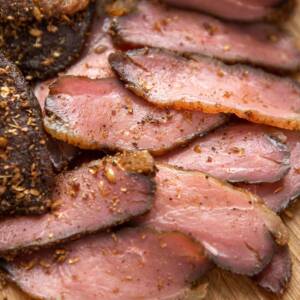
Duck Biltong
Duck Biltong is a delicious savoury, dried meat snack, anyone can make at home with minimal equipment and basic cooking knowledge. It's based on my famous beef biltong recipe, South Africa's most popular dried meat snack along with droëwors.
Servings 12 portions
Ingredients
Meat
- 1500 grams (3 ⅓ lb) Duck breast - Trimmed weight from 2 kg duck (note 1)
- 90 grams (⅓ cups) Coarse sea salt - Note 2
Spices
- 80 grams (1 cups) Coriander seeds
- 20 grams (2 tablespoons) Black peppercorns
- 6 grams (1 tablespoons) Garlic powder
- 10 grams (1 ½ tablespoons) Smoked paprika
Liquid
- 130 grams (½ cup) Apple cider vinegar - Note 3
- 30 grams (2 tablespoons) Worcestershire sauce - Note 4
- 20 grams (1 tablespoon) Honey - Note 5

Instructions
- Trim up the duck breasts. Remove any excess fat and all the visible silver skin and sinew. Leave enough fat to cover the breast on one side. Pluck out any feathers that might be left. Do not burn them off with a blow torch as this will result in them still being left in the skin anyway.
- Once cleaned and trimmed, rinse under cold water to clean. Dry with a paper towel and weigh out the meat. Multiply the weight in grams by 0.06(6%). This is the amount of course ground salt you need to use.
- Salt the duck breasts all over and let it cure on the skin side for 30 minutes. After 30 minutes, flip the meat, and cure for another 30 minutes. Once cured, you remove the salt by simply wiping it off with a cloth. Do not rinse with water.
- While the meat cures in the salt, you can make the spice mix. Roast the coriander seeds in a dry pan until nice and fragrant. Blend in a coffee blender until flaky but not fine. Blend the pepper without toasting in a pan and blend to a medium fine powder. Add the smoked paprika and dried garlic, before giving it all a nice mix to combine. Spread onto a tray and set aside for now.
- Mix the wet ingredients and pour over the salted duck breasts into a non-reactive container. Soak the meat for an hour in the marinade, flipping over every 15 minutes to make sure it marinates evenly. After an hour, remove from the marinade and pat dry with paper towels.
- Place the duck breasts into the spice mix and press the spice into the flesh. Leave it to stand for 5 minutes, then repeat the spicing so that more spice sticks to the meat. Once spiced, you ideally need to weigh each duck breast. Label them individually to track the weight loss while drying. You can hang it on non-reactive metal or plastic meat hooks if drying in a biltong box or simply open space. If drying in a dehydrator use toothpicks to stick the weight label onto.
- For most people, especially those living in small apartments or humid climates, drying the biltong in a dehydrator is the best option. Set the temperature to a minimum. Don't set a timer. Place a cheap thermometer with a wire probe into the dehydrator to monitor the temperature. Not all dehydrators are accurate. It will take about 2–3 days to dry.
- Dry the duck until it's lost 50% of its weight. Ideally, you vacuum seal it tightly once cured to even out the moisture and mature the texture and flavour. Keep it in the fridge for 2 to 3 days before slicing. If you don't have a vacuum sealer, you wrap it tightly in plastic wrap instead. After this, you can freeze it for long storage. It will keep vacuum-sealed in the fridge for a few months.
Video
Notes
- Keep the trimmings from the duck breasts to render down duck fat to use in cooking or to make duck mince. It can be stored in the freezer for up to a year.
- Important to use coarse ground salt. Table salt won't work. It can be from any source, but it has to be coarse ground.
- Use any vinegar you have for this, apart from distilled vinegar. Malt, wine-based or fruit-based are all good.
- If you don't have Worcestershire or you don't like it, then substitute it for soy sauce or leave it out.
- Honey is optional, and you can either leave it out or simply add some sugar to replace it.
- See the post for details on substitutions, and drying options.
- If you see mould growing, wipe it off with a cloth dipped in vinegar straight away. Increase the airflow and decrease the humidity.
Nutrition
Serving: 100grams Calories: 191kcal Carbohydrates: 7g Protein: 26g Fat: 7g Saturated Fat: 2g Polyunsaturated Fat: 1g Monounsaturated Fat: 2g Cholesterol: 96mg Sodium: 500mg Potassium: 496mg Fiber: 4g Sugar: 2g Vitamin A: 488IU Vitamin C: 9mg Calcium: 66mg Iron: 7mg
Keywords:biltong, duck biltong
Did you make this?Tag @pantsdownapronson or hashtag #pantsdownapronson so I can see your hot skills!