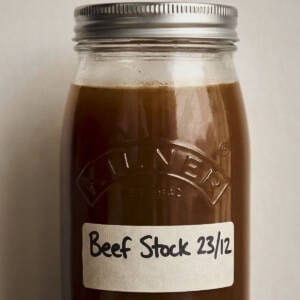
Homemade Beef Stock
Homemade beef stock is a simple way to improve your cooking and achieve restaurant-quality dishes without spending much money. It far surpasses store-bought stock, as you have complete control over every ingredient and the cooking process. This allows you to use the stock in a variety of dishes without worrying about them being too salty or bland.
Servings 2 Liters/ Quarts (8 cups)
Ingredients
- 3 kg beef bones - note 1
- 1 large carrot - peeled or unpeeled, cut into chunks
- 1 large onion - peeled or unpeeled, white, red, or brown, cut into chunks. Can also use leeks as a substitute.
- 1 celery stalk - well rinsed and cut into chunks, leaves and all
- 1 whole garlic - whole head cut in half
- 50 grams tomato paste - not tomato pasata, which is not concentrated.
- 2 grams peppercorns - whole (optional)
- 4 sprigs thyme - whole sprigs, or 1 teaspoon dried leaves (optional)
- 4 whole bay leaves - fresh or dried (optional)
- 350 ml red wine - dry red wine for deglazing the pan fond. (optional)
- 4 litres water - drinkable cold tap water

Instructions
Roasting the bones
- Preheat your oven to 230°C (446°F). Place the beef bones on a roasting tray and roast until they reach a deep golden brown color.3 kg beef bones
- Prepare aromatics. While the bones roast, peel and chop the carrots and onions into large chunks. Chop the celery, halve the garlic horizontally, and add them to the stockpot with bay leaves, thyme, peppercorns, and tomato paste.1 large carrot, 1 large onion, 1 celery stalk, 1 whole garlic, 50 grams tomato paste, 2 grams peppercorns, 4 sprigs thyme, 4 whole bay leaves
Deglazing the fond
- Deglaze the tray. Remove the roasted bones from the tray, leaving the rendered fat behind. Use red wine or water to scrape the caramelized fond from the bottom of the tray.350 ml red wine
- Combine ingredients. Add the roasted bones and the deglazed fond to the stockpot. Avoid adding the pool of rendered fat from the tray to the pot. Store the rendered fat in the fridge and use for frying when cooking other dishes.
Cooking stock
- Cover with water. Fill the pot with water until the ingredients are just submerged. Do not overfill.4 litres water
- Simmer and skim. Bring the liquid to a bare simmer where only small bubbles surface. Periodically skim any froth or fat that rises to the top. Add a small amount of water if the bones become exposed.
- Extract flavor. Continue simmering for 6 to 12 hours. The stock is ready once the flavor and nutrients have fully transferred from the bones into the liquid.
Straining and storing
- Strain the stock. Pass the liquid through a fine-mesh sieve. For a clearer restaurant-style finish, perform a second strain through a muslin cloth.
- Chill quickly. Transfer the stock to containers and place them in an ice water bath to reach room temperature quickly before refrigerating.
- Remove solidified fat. Once chilled, remove the layer of solidified fat from the surface with a spoon. Discard this in the bin, not the sink.
- Seal and label. Label the containers and store them in the refrigerator or freezer.
Video
Notes
- Bones — The best bones to use are joint bones. However, they are too large for a regular home cook's stock pot. Ask your butcher to cut these up into manageable pieces no bigger than a tennis ball. Alternatively, most stores will sell packs of bines called "soup bones" Or "stewing bones". These will also work great.
- Alcohol free — Dry red wine is classically used, but feel free to omit it if you don't use alcohol products. The color might be a touch lighter, but the stock will still be great.
- Substitutions and additions — You can add tomato trimmings or overripe tomatoes to use up, as well as mushrooms. These are high in umami, which will enhance the stock's flavor. Additionally, you can substitute or add coriander seeds along with the peppercorns. These add depth but aren't prominent in the final stock.
- Yield — This recipe yields 2 litres (quarts) of stock, which you can reduce further to intensify the flavor if needed, or keep as is for a base.
- Oven — Instead of cooking it on the stove all day, place the pot in the oven at 130 °C (266 °F), with the lid on, after bringing it to a simmer and skimming off the impurities once. This method allows for a safe overnight version or while you're doing other things. It also prevents excessive moisture evaporation.
- Slow cooker — If you have a large enough slow cooker, this method is also a convenient set-and-forget option. Follow all the steps and skim the stock once before you let it cook, and once it's cooled.
- Pressure cooker — Pressure cookers work quickly to make a very good-tasting stock, turning a long process into a few hours. However, make sure there is very little fat in the pot to start with, and do not let the stock boil before closing the lid. After 3 hours under pressure, let the valve release naturally so the stock does not end up cloudy.
- Salting at the start will prevent full extraction of flavor and nutrients from the bones and aromatics.
- Reducing a salted stock for sauces or in braises will result in an overly salty dish that can't be saved.
Nutrition
Serving: 250grams Calories: 50kcal Carbohydrates: 3g Protein: 6g Fat: 1g Saturated Fat: 0.1g Polyunsaturated Fat: 0.2g Monounsaturated Fat: 0.1g Potassium: 462mg Sugar: 9g Calcium: 20mg Iron: 1mg
Keywords:beef stock recipe, homemade beef stock, how to make beef stock
Did you make this?Tag @pantsdownapronson or hashtag #pantsdownapronson so I can see your hot skills!