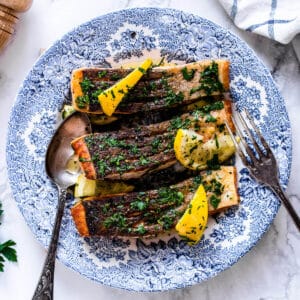
How to cook salmon fillet in a pan
The perfect way to pan-fry salmon fillets. Crispy skin, juicy flesh and a deliciously simple lemon parsley butter.
Servings 3 portions
Ingredients
- 3 salmon fillets - note 1
- 50 g neutral oil - note 2
- 50 g butter - note 3
- 10 g parsley - finely chopped - note 4
- 1 lemon - note 5
- salt and pepper to taste

Instructions
- Before you start cooking, make sure the skins of the salmon fillets are dry. Moisture is the enemy when frying fish — it makes the skin stick and the oil spit as the moisture hits the pan. Press a piece of kitchen towel firmly against the skin and flesh until the surface is dry to the touch before frying.3 salmon fillets
- Heat the pan with a generous amount of neutral or light olive oil over high heat. When the oil is hot and just starts to smoke, it is time to add the fish. Season the salmon liberally on the skin side only. Carefully place the fillet skin-side-down, laying the near edge in first so the oil runs away from you, and cook 1 minute on high heat.3 salmon fillets , 50 g neutral oil, salt and pepper to taste
- Turn the heat down to medium and keep frying skin-side down for about 3 minutes, until the color of the flesh turns opaque roughly two-thirds of the way up the side of the fillet. Flip and cook 30 to 45 seconds on the flesh side. Depending on the thickness and size of your fillets, times may vary.
- For a medium-rare center, pull the fillets from the pan when they read 40°C / 104°F at the thickest point. The center will still look translucent at this stage — that is correct. Rest the fillets skin-side up for 3 minutes. Carry-over heat carries the center just past 42°C / 108°F, into the mid-40s°C, for a silky, just-set finish. No temperature probe? Insert the tip of a knife into the thickest part of the fillet for 3 seconds, then touch the tip to the inside of your wrist — it should feel cool-to-lukewarm, not hot. For fully cooked salmon, pull at 50°C / 122°F and rest to about 52–54°C / 125–129°F.
- While the fish rests, place 50 g of butter into the pan over medium heat. Cook for about 1 minute, just until the butter starts to bubble and foam. Remove the pan from the heat.50 g butter
- Squeeze in a touch of lemon juice. Add the chopped parsley and a fresh grating of black pepper. Return the fillets to the pan skin-side up, glaze with a little of the butter, and serve immediately.10 g parsley, 1 lemon
Notes
- Temperature — This recipe takes the salmon to medium-rare. Pull the fillets at 40C / 104F and rest them for 3 minutes. Carry-over heat carries the center just past 42C / 108F for a silky, just-set finish. If you like it cooked all the way through, pull at 50C / 122F instead and rest to about 52-54C / 125-129F. Above 60C / 140F it dries out. One thing to know: a medium-rare center is not fully cooked, so use sushi-grade or previously-frozen salmon, and cook it all the way to the USDA's 63C / 145F if you are serving anyone pregnant, very young, elderly, or with a weak immune system.
- You can also use this method to cook other types of fish fillets. Whenever buying fish make sure it's as fresh as possible. Good quality fresh fish does not smell fishy, the flesh is firm and not slimy, and the color is vibrant.
- Choose your favorite, just make sure it has a high smoking point.
- Adding butter is optional. If you want to keep it lighter simply add a bit of olive oil at this stage or skip the step.
- Use any other herb or a mixture of herbs. This step is also optional and you can simply skip it if you don't want the herbs.
- Citrus goes well with fish. You can substitute the lemon for lime, or if you have something against sharpness simply leave it out, although adding it is highly recommended.
- If you do not have a good pan, use a piece of baking parchment to fry on. Place it into the pan and follow the instructions as described.
- I highly recommend you get a kitchen thermometer. It is an inexpensive, invaluable tool we use constantly in the kitchen.
- To cook a salmon steak on the bone, use the same temperature guide and measure the temperature close to the bone.
Nutrition
Serving: 120g Calories: 517.63kcal Carbohydrates: 0.22g Protein: 24.74g Fat: 46.32g Saturated Fat: 14.53g Trans Fat: 0.55g Cholesterol: 101.83mg Sodium: 74.83mg Fiber: 0.11g Sugar: 0.04g Vitamin A: 14.23IU Vitamin C: 10.13mg Calcium: 1.96mg Iron: 3.95mg
Keywords:how to pan fry salmon fillet, pan fried salmon fillet
Did you make this?Tag @pantsdownapronson or hashtag #pantsdownapronson so I can see your hot skills!