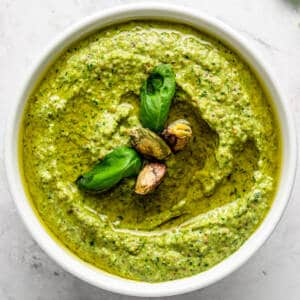
Pistachio Pesto Recipe
Pistachio pesto made with basil and Sicilian pistachios blitzed in 2 minutes into a vivid sauce that coats pasta, finishes grilled veg, can be eaten like a dip with crudités, and freezes for months.
Servings 10 servings
Ingredients
- 135 grams (1 cups) pistachios - shelled
- 50 grams (2 cups) Fresh basil leaves - picked from the stalks
- 100 grams (½ cups) Extra-virgin olive oil
- 50 grams (½ cups) Parmesan - finely grated
- 5 grams (1 clove) Garlic
- 15 grams (1 tablespoon) Lemon juice - ½ lemon 1 Tbsp
- Salt and black pepper
- 30 grams (2 tablespoon) water or extra oil for thinning - optional

Instructions
- Load the bowl: Add pistachios, basil, Parmesan, garlic, lemon zest, and salt to a food-processor bowl (or a large mortar).
- Make the paste: Mortar: pound to a coarse paste, then work in the olive oil until glossy. Processor: run on low and drizzle in the olive oil until the pesto turns smooth, pausing once to scrape the sides.
Notes
- Pistachios — Start with raw, unsalted kernels. For a deeper, toasted flavor, bake 8–10 min at 175 °C / 350 °F until fragrant, then cool before blitzing.
- Basil — Weigh leaves after removing thick stems and spin-dry well; surface water thins the sauce.
- Cheese — Parmigiano Reggiano aged ≥ 24 months gives the best flavor. Pecorino works if you like a sharper edge.
- Olive oil — Choose a mild, fruity oil; very peppery oils can be too bitter.
- Consistency tweaks — For pasta, whisk in 15–30 ml / 1–2 Tbsp cold water to loosen. Keep it thick for spreads or as a dip with crudités.
- Processor vs. mortar — A mortar delivers a rustic, chunkier pesto; the food processor is faster and yields a smoother sauce.
- Salt timing — Blend first, then taste; pistachios and cheese both contain natural salt, so you may need less than expected.
- Fridge storage — Pack into a small jar, level the top, and cover with a 2 mm / ¹⁄₁₆ in olive-oil seal. Store at ≤ 4 °C / 40 °F and use within 3 days for peak color and flavor. Some cooks report acceptable quality up to a week if the oil film stays intact.
- Freezer storage — Portion into silicone ice-cube trays, freeze solid, then bag the cubes. Quality holds for about 3 months at −18 °C / 0 °F. Thaw overnight in the fridge, or melt a cube straight into hot food.
- Yield & scaling — This batch makes roughly 250 g / 1 cup—enough for 4 servings of pasta. Double or triple the recipe by maintaining the same ratios.
Nutrition
Serving: 25grams Calories: 186kcal Carbohydrates: 4g Protein: 5g Fat: 17g Saturated Fat: 3g Polyunsaturated Fat: 3g Monounsaturated Fat: 11g Cholesterol: 3mg Sodium: 81mg Potassium: 161mg Fiber: 1g Sugar: 1g Vitamin A: 359IU Vitamin C: 2mg Calcium: 83mg Iron: 1mg
Keywords:pistachio basil pesto, pistachio pesto
Did you make this?Tag @pantsdownapronson or hashtag #pantsdownapronson so I can see your hot skills!