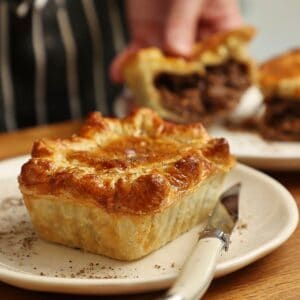
South African Pepper Steak Pie (Garage Pie)
Flaky rough puff pastry filled with braised beef in a rich peppery gravy. The authentic South African garage-pie.
Servings 6 individual pies
Ingredients
For the pastry
For the filling
- 15 grams (1 tablespoon) vegetable oil - or olive oil, or beef dripping for frying
- 500 grams (1.1 lb) beef - chuck or stewing beef, diced into roughly 3 cm chunks
- 30 grams (3 ½ tablespoon) flour - all-purpose
- 1 (1 large) large onion - finely chopped
- 125 grams (½ cup) water - to deglaze pan fond
- 4 cloves (4 cloves) garlic - minced
- 500 grams (2 cups) beef stock
- 20 grams (2 tablespoon) Worcestershire sauce
- 5 grams (1 tablespoon) black peppercorns - toasted and coarsely cracked
- 5 grams (1 tablespoon) coriander seeds - toasted and coarsely cracked
- ⅓ (½ teaspoon) nutmeg - freshly grated
- 9 grams (1 ½ teaspoon) salt
- 15 grams (1 tablespoon) malt vinegar - optional, for balance
For assembling
- 2 (2) egg yolks
- 20 grams (4 teaspoon) water

Instructions
- Make the pastry. Whisk the flour and salt together in a large bowl. Add the very cold cubed butter and toss through the flour until every piece is coated. Do not rub the butter in — those whole cubes become steam pockets in the oven. Add the ice-cold water and mix gently with a fork until you have a shaggy mess with butter lumps everywhere. Tip onto a floured surface, press into a rough rectangle, then fold into thirds like a letter. Wrap in parchment and chill for at least 1 hour.
- Toast the spices. In a dry pan on medium heat, toast the black peppercorns and coriander seeds for about 1 minute, tossing often, until fragrant. Do not burn. Crack them coarsely in a pestle and mortar or spice grinder — keep them coarse, not powdered. Set aside.
- Sear the beef. Toss the beef chunks with the flour until coated. Heat the oil or beef dripping in a heavy pot on high heat. Sear the beef in batches until heavily browned all over. Do not overcrowd the pot. Remove the beef and set aside. Do not clean the pot — the brown crust (fond) is the flavor foundation.
- Cook the onions and build the base. Turn the heat to low. Add the onions and garlic to the pot and cook gently until soft and translucent, scraping up the fond. Add the salt to help the onions release moisture. Once the fond is picked up, add the 125 ml water and let it stew for 2 minutes.
- Braise the beef. Return the beef to the pot. Add the beef stock, Worcestershire sauce, malt vinegar (if using), and the cracked toasted spices. Mix well. Bring to a gentle simmer, then turn the heat down to low. Cover with a cartouche (parchment paper cut to fit) or a lid. Simmer gently for 1.5–2 hours until the beef is fork-tender, stirring occasionally. Alternatively, braise in the oven at 160°C (320°F) for 1.5–2 hours.
- Roll and fold the pastry (second session). While the beef braises, take the chilled pastry out and let it sit for 5 minutes. On a floured surface, roll it into a 40 x 20 cm (15 x 7 inch) rectangle. Letter-fold it (one third down, the other third over), turn 90 degrees, and repeat the rolling and folding two more times for a total of three letter folds. Wrap and return to the fridge.
- Finish the filling. Once the beef is fork-tender, break up the meat slightly with a fork — you want some chunks, not shredded bits. The filling should be glossy and coating-thick. Transfer to a container, cover with parchment, and chill completely in the fridge. Warm filling will melt the pastry.
- Line the tins. Let the pastry come to temperature for 5 minutes, then roll it out to 3 mm thick. Cut circles with generous overhang and line your pie tins (250 ml / 1 cup individual tins or one 23 cm / 9 inch tin). Snip off excess, leaving enough for crimping. Chill the lined tins. Cut lids with a slight overhang and chill those too.
- Assemble the pies. Heat the oven to 180°C (356°F). Grate the fresh nutmeg into the cold filling and mix. Fill the lined tins generously to the top. Beat the egg yolks with the 20 ml water, pass through a sieve, then brush the pastry edges. Add the lids and seal tightly. Crimp the edges with a fork. Brush with egg wash all over. Chill for 5 minutes, then apply a second coat of egg wash and cut a small steam vent in the center of each pie.
- Bake. Bake for 35 minutes, rotating the tray halfway, until deep golden brown and blistered on top. For a large pie, bake 45–50 minutes. Let cool for 15–20 minutes before serving — the filling is extremely hot.
Video
Notes
- The beef — Chuck is the default, but any well-marbled braising cut works — beef cheek or short rib meat off the bone. The fat and connective tissue break down into gelatin over the long braise, which is what makes the gravy glossy and the meat tender. Skip lean cuts like eye of round or fillet. They cost more and cook up dry and stringy. Cut into 3 cm (just over 1 inch) pieces so they brown properly and still hold their shape after a couple of hours in the pot.
- The pepper — This is a pepper pie, so the pepper is the main flavor and worth getting right. Black peppercorns are the classic choice. Toast them and crack them coarse rather than grinding to powder, so you get pockets of heat instead of a flat, even burn. White pepper gives a cleaner, sharper heat if you like that. Fresh or salt-packed green Kampot pepper is milder and brighter with a citrusy edge — it's soft, so skip the dry-toast, crush it, and stir it in near the end. If you use the salt-packed kind, cut back on the added salt because it comes already seasoned.
- The pastry — Two things make rough puff flaky: cold butter and a light hand. Keep the butter almost frozen and mix just until the dough holds, with streaks and lumps of butter still visible — not a smooth dough. Those butter layers turn to steam in the oven and push the pastry apart into flakes. Overwork it, or let the butter warm and melt in, and you get a dense, greasy crust instead. For a shortcut, store-bought all-butter puff works — about 500 g (1.1 lb) for six pies — though scratch rough puff bakes up flakier and holds its shape better.
- Assembly, keep everything cold — Your filling has to be fridge-cold before it goes anywhere near the pastry. Warm filling melts the butter in the crust and the base turns greasy and heavy. Fill each tin to just below the rim, not over it, or the pies leak and the lid won't seal. Brush the pastry rim with egg wash first — it works like glue between base and lid — then press the edges together and crimp firmly. Cut a small vent in each lid so steam escapes upward instead of building under the lid and steaming the crust soft.
- A crisp base, not a soggy one — The disposable aluminum tins earn their place — thin metal conducts heat fast and helps set the bottom crust. Bake on the lowest oven rack, or slide the tins onto a baking tray you've preheated, so the base gets direct heat early and colors instead of steaming. Keep that steam vent open. Between a cold filling, a hot tray, and an open vent, the bottom bakes through rather than going pale and damp.
- How to tell it's done, without a thermometer — Three things. The beef should give almost no resistance to a fork and break into chunks, not shred to mush. The gravy should be glossy and coat the back of a spoon — not soupy, not a stiff paste. The pastry should be deep golden all over. Lift a pie and check the underside is set and colored before you pull the tray. A pale base means it needs a few more minutes.
- Other cooking methods — The filling is a straight beef braise, so it takes to other methods well. Oven: covered at 160°C (320°F) for 3.5 hours, until the beef is fork-tender. Slow cooker: low for 6 to 8 hours. Pressure cooker: about 35 to 45 minutes at high pressure, then simmer the gravy uncovered to reduce it, since pressure cooking holds the liquid in. [The slow-cooker and pressure-cooker times are starting points, so cook until fork-tender for your equipment.]
- If the gravy is too thin or too thick — Remember it firms up as it cools, so in the pie it wants to be spoonable and glossy, not runny. Too thin at the end of the braise: simmer it uncovered to reduce, or stir in a teaspoon of cornstarch slaked in cold water and cook a minute. Too thick or pasty: loosen it with a splash of hot stock. Get it right before it goes cold and into the pastry — a runny filling soaks the base, and a stiff, pasty one won't settle into the corners.
- 9. Make-ahead and storage — Both the pastry and the filling keep in the fridge for up to 3 days, stored separately. Assemble and bake on the day you want to eat them — raw assembled pies hold only about a day in the fridge before the pastry softens. To freeze, freeze the raw assembled pies solid on a tray, then wrap each one. They keep 3 months raw, or 2 months baked. Reheat baked pies in the oven at 160°C (320°F), 15 to 20 minutes from the fridge or 20 to 25 from frozen. Skip the microwave — it warms the filling but turns the pastry soft.
Nutrition
Serving: 350grams Calories: 513kcal Carbohydrates: 52g Protein: 10g Fat: 30g Saturated Fat: 17g Polyunsaturated Fat: 3g Monounsaturated Fat: 8g Trans Fat: 1g Cholesterol: 131mg Sodium: 1388mg Potassium: 523mg Fiber: 4g Sugar: 4g Vitamin A: 1564IU Vitamin C: 14mg Calcium: 64mg Iron: 4mg
Keywords:pepper steak pie
Did you make this?Tag @pantsdownapronson or hashtag #pantsdownapronson so I can see your hot skills!