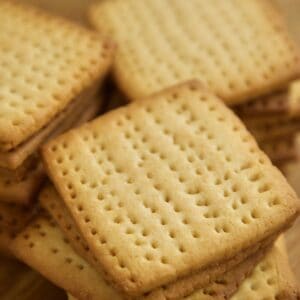
Tennis Biscuits (South African Coconut Shortbread)
Thin, crisp South African coconut shortbread squares — the base for peppermint crisp tart and other fridge desserts, made with condensed milk and blended coconut for authentic Bakers-style texture.
Servings 22 biscuits
Ingredients
- 40 grams (½ cup) desiccated coconut
- 240 grams (2 cups) flour - all purpose
- 50 grams (½ cup) powdered sugar
- 8 grams (1 ½ teaspoon) baking powder
- 3 grams (½ teaspoon) salt
- 113 grams (½ cup) salted butter
- 80 grams (¼ cup) sweetened condensed milk
- 1 (1) large egg - beaten

Instructions
- Blend the desiccated coconut in a food processor, pulsing briefly until the oils just start to glisten — about 5–10 seconds. Stop before it becomes a paste. This releases coconut flavor without adding moisture or turning it into coconut butter.
- Sieve the flour, powdered sugar, and baking powder into a large bowl to aerate the flour and prevent lumps. Add the salt and blended coconut to the sieved dry ingredients. Whisk briefly to distribute evenly.
- Rub in the melted butter using your fingertips, working swiftly until the mixture resembles damp sand. The butter should be melted but not hot — if it's just off the stove, let it cool for a few minutes so it doesn't cook the egg when you add the wet ingredients.
- Beat the egg and condensed milk together in a separate bowl until smooth and combined.
- Add the wet ingredients to the dry mixture and stir with a fork until you have a shaggy, sticky dough. It will look too wet at first — this is correct. Don't add extra flour.
- Bring the dough together with your hands, working it briefly until it becomes a smooth, cohesive paste. It will feel sticky initially, then firm up as you knead for 30–60 seconds. The dough is ready when it no longer clings to your fingers and holds together in a ball.
- Wrap the dough in plastic wrap or greaseproof paper and refrigerate for 30 minutes. This firms the dough so it's easier to roll without sticking.
- Roll the chilled dough between two sheets of parchment paper to 3–4 mm thickness — aim for 3 mm if you can manage it for the crispest texture. If the dough softens and becomes difficult to handle, place it in the freezer for 5 minutes to firm up again. Work gently — the dough is soft and delicate.
- Cut the dough into 8 cm (3 inch) squares using a sharp knife or pastry cutter. Dock each square all over with a fork, pressing firmly enough to make clear marks but not so hard you tear the dough. The docking prevents bubbling during baking and gives the characteristic tennis biscuit appearance. Place the cut squares on a parchment-lined tray and freeze until solid — about 15–20 minutes. The dough is soft and high-fat, so freezing makes the squares transferable without distortion. Trim any uneven edges and save the scraps — you can re-roll them for more biscuits.
- Heat the oven to 180°C/350 °F (160°C fan / 320°F). Prepare a baking tray lined with parchment paper. Working quickly while the dough is still frozen, transfer the squares to the prepared tray, leaving 2 cm (1 inch) space between each. Bake for 10 minutes, then rotate the tray and bake for 6–8 minutes more until dark golden brown — the edges should be deeply caramelized, not blonde. The edges and corners will brown faster than the centers. Watch closely and pull edge pieces as soon as they're dark golden. Let center pieces finish for another 2–3 minutes if needed. Some pieces will cook quicker than others — swap positions, rotate the tray, or remove individual pieces as you see fit. This is not your regular cookie — the thin dough and high sugar content make them unforgiving to heat.
- Cool the biscuits on a wire rack until completely cold. They will crisp further as they cool. Don't stack them or leave them on the hot tray — they'll steam and soften.
Video
Notes
- Desiccated coconut — Blend briefly in a food processor until the oils just start to release and glisten, then stop. This increases coconut flavor without adding moisture. If you don't have a food processor, use desiccated coconut as-is and increase the quantity to 50 g (⅔ cup) to compensate for the milder flavor.
- Condensed milk — This is the key ingredient for moisture, sweetness, and caramelization. If unavailable, substitute 60 ml (4 tbsp) golden syrup + 30 ml (2 tbsp) whole milk, but the texture will be less rich and more like standard shortbread.
- Chill and freeze — The dough needs chilling after mixing (30 minutes) to make it rollable, then the cut squares need freezing (15–20 minutes) to make them transferable to the tray without distortion. Don't skip the freeze step — the dough is too soft to handle cleanly otherwise.
- Rolling thickness — 3–4 mm is the target. Thinner is better for the crisp snap — thicker biscuits lose the characteristic texture and end up more like shortbread cookies. Use the parchment-paper sandwich method to prevent sticking without adding extra flour.
- Dark golden doneness — These need deep color for flavor. The caramelization of the condensed milk and sugar is what makes them taste right. Blonde biscuits are underbaked and will be soft and bland. Aim for dark golden edges with darker corners — this is correct, not burnt.
- Uneven browning is normal — The thin dough and high sugar content mean edges and corners brown faster than centers. Rotate the tray halfway through and pull pieces individually as they're ready. Some batches need 14–16 minutes total, and some pieces may be done at 12 — watch them closely and use your judgment.
- Storage and re-crisping — Airtight container at room temperature for 7–10 days. They may soften slightly after day 5 — to re-crisp, place in a 150°C (300°F) oven for 3–4 minutes, then cool completely before serving. To freeze, layer baked and cooled biscuits between parchment in a freezer-safe container for up to 3 months, and thaw at room temperature for 30 minutes.
- Make-ahead — The dough can be wrapped tightly and refrigerated for up to 2 days, or frozen for up to 1 month. Thaw frozen dough in the refrigerator overnight before rolling. Cut, unbaked squares can be frozen on a tray, then transferred to a freezer bag and baked directly from frozen — add 2–3 minutes to the baking time.
- Uses — Tennis biscuits are the traditional base for peppermint crisp tart and other South African fridge desserts. They also work as a crushed cheesecake base, dunked in rooibos tea or coffee, or eaten on their own.
Nutrition
Serving: 30grams Calories: 112kcal Carbohydrates: 13g Protein: 2g Fat: 6g Saturated Fat: 4g Polyunsaturated Fat: 0.3g Monounsaturated Fat: 1g Trans Fat: 0.2g Cholesterol: 20mg Sodium: 133mg Potassium: 39mg Fiber: 1g Sugar: 4g Vitamin A: 149IU Vitamin C: 0.1mg Calcium: 36mg Iron: 1mg
Keywords:tennis biscuits
Did you make this?Tag @pantsdownapronson or hashtag #pantsdownapronson so I can see your hot skills!