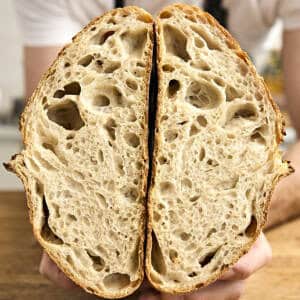
Easy Sourdough Bread (No kneading, No Autolyse, No Pre-Shape)
A streamlined, beginner-friendly sourdough recipe that skips the complicated autolyse and pre-shaping steps. This method relies on simple folds and visual cues to deliver a loaf with a blistering crust and a soft, airy crumb.
Servings 1 loaf(
Ingredients
- 375 grams (1½ cups) water
- 100 grams (⅖ cup) rye starter
- 12 grams (2 teaspoon) salt
- 450 grams (3 ⅔ cups) white bread flour
- 25 grams (3 ½ tablespoon) whole wheat flour
- 25 grams (3 ⅓ tablespoon) rye flour

Instructions
Build the Levain (6-8 hours before mixing dough)
- In a jar, mix the 20g starter, 40g white flour, 10g rye flour, and 50g water. Cover loosely and leave at room temperature until it triples in volume, is highly bubbly, and domed on top. (Note: This makes 120g of levain. You will use 100g and have 20g left over to feed as your ongoing starter).
Mix the Dough & First Rest
- Place a large bowl on a digital scale. Whisk together the 375g water, 100g active levain, and 12g salt until milky. Add the 450g white flour, 25g rye, and 25g wholemeal. Mix with a dough scraper or your hands until a rough, shaggy dough forms with absolutely no dry spots.
The "Drunk Cat" Fold
- Wet your hands. Grab the dough from the middle, lift it up so the ends hang down, and fold it in on itself to roughly shape a ball. Cover the bowl with a damp towel and rest at room temperature for 30 minutes.
Slap and Folds (4 Sessions total)
- After 30 minutes, wet your hands. Grab the dough, slap the bottom end against the counter, and fold the top over toward you. Give it a quarter turn and repeat 2 or 3 times until the dough feels tight and resists stretching. Place it back in the bowl, cover, and rest 30 minutes. Repeat this exact folding and resting process 3 more times. 5. Bulk Fermentation (Watch the dough, not the clock)
- After your final fold, cover the bowl and let it sit at room temperature (24°C–27°C / 75°F–80°F). Do not let it double in size. The bulk ferment is finished when the dough has risen by roughly 75%, is visibly domed on top, and jiggles like set gelatin when you shake the bowl.
Shape and Cold Retard
- Turn the dough onto a lightly floured surface. Fold the top down to the middle, fold the sides into the center, and tightly roll it from top to bottom into a log. Drag it gently toward you to create surface tension. Place it seam-side up into a proofing basket heavily dusted with rice flour. Pinch the seam shut, seal the whole basket in a plastic bag, and refrigerate for 12 to 24 hours.
Preheat the Oven (Do this first!)
- Leave the dough in the fridge. Place your Dutch oven (with the lid) into the oven and preheat to 250°C (480°F) for one full hour.
The Poke Test & Scoring
- Once the oven is screaming hot, take the dough out of the fridge. Gently poke it with a floured finger. If the indent springs back slowly and stops halfway, it is ready. Turn the dough out onto a piece of parchment paper. Using a sharp razor (lame), make one confident, deep score (about ½ inch) down the center at a slight angle.
Bake
- Use the parchment paper to carefully lower the dough into the hot Dutch oven. Put the lid on and bake covered at 230°C (445°F) for 20 minutes. Remove the lid, drop the temperature to 200°C (390°F), and bake uncovered for another 20 to 25 minutes until deeply browned.
Cool Completely
- Transfer the loaf to a wire rack. Let it cool for at least 2 full hours before slicing to prevent a gummy crumb.
Video
Notes
(Read Before Baking!)
-
Ingredients & Substitutions
- Flour substitutions: If you don't have rye or wholemeal flour, simply replace them with an additional 50g of strong white bread flour. Your loaf will still bake beautifully.
- Water quality: Heavy chlorine can inhibit yeast. Use filtered water, or leave an open jug of tap water on the counter overnight so the chlorine can evaporate before mixing.
- The "float test" myth: Do not drop the starter in water to test it—dense rye and wholemeal flours can cause a perfectly good starter to sink. If your levain has tripled in volume and is full of bubbles, it is ready.
- Wet hands, not floured hands: Never add extra flour to the bowl to prevent sticking, as this lowers hydration and makes dense bread. Dip your hands in a bowl of water before handling the dough.
- Why rice flour? Standard wheat flour acts like glue in the fridge. Rice flour acts like tiny ball bearings. Heavily dusting your basket with rice flour is the only foolproof way to ensure a clean release.
- Dutch oven sizing: A 4-quart to 5-quart (roughly 4 to 5 liters) Dutch oven is ideal. It forces the dough to rise into a tall loaf rather than spread out wide.
- Tracking your folds: It’s easy to forget how many folds you've done over two hours. Keep a scrap of paper nearby and draw a tally mark after each session so you know exactly when you hit four.
- Watch the dough, not the clock: The times listed are guidelines based on a warm kitchen (24°C / 75°F). Trust the physical cues (75% rise, domed top, jiggle) over your timer.
- The #1 rule of bulk fermentation: If your dough turns into a sticky, soupy puddle, it is over-fermented. For beginners, it is always safer to slightly under-proof than to let it double in size at room temperature.
- Schedule flexibility: The cold retard is a pause button. While 12 to 24 hours is standard, you can leave the dough in the fridge for up to 36 hours. A longer rest yields a more intense sour flavor.
- Prevent a burnt bottom crust: Cast iron retains intense heat. Place a bare aluminum baking sheet on the oven rack directly beneath your Dutch oven to deflect the direct heat away from the base.
- No razor? Use scissors: Do not use a standard kitchen knife to score—it will drag and deflate your dough. Instead, make a row of deep, angled snips down the center with clean kitchen scissors for a beautiful, spiked crust.
- Baking without a Dutch oven: Place the scored dough on a parchment-lined baking sheet. Heavily spray the dough with water, cover with an inverted roasting pan or deep foil tray, and bake for 15 minutes before uncovering.
- Never refrigerate sourdough: The fridge alters the starches and makes bread go stale rapidly. Keep it cut-side down on a wooden board for the first 12 hours to maintain the crust.
- The freezer method: For long-term storage, slice the fully cooled loaf and freeze the slices in a zip-lock bag. Toast them directly from frozen.
- Refreshing a soft crust: If you wrapped your cut loaf in plastic or a tin, the crust will soften. To bring back the crunch, lightly mist the outside of the loaf with water and bake directly on the oven rack at 200°C (390°F) for 5 to 10 minutes.
Nutrition
Serving: 100grams Calories: 211kcal Carbohydrates: 40.3g Protein: 7.2g Fat: 1g Saturated Fat: 1g Polyunsaturated Fat: 1g Monounsaturated Fat: 1g Sodium: 493mg Potassium: 85mg Fiber: 2.4g Calcium: 11mg Iron: 1mg
Keywords:beginner sourdough recipe, easy sourdough bread, no knead sourdough bread
Did you make this?Tag @pantsdownapronson or hashtag #pantsdownapronson so I can see your hot skills!