

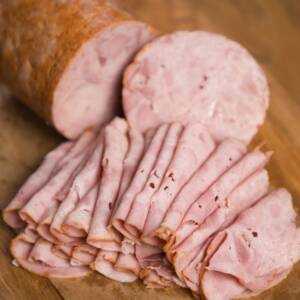
Making homemade turkey deli ham, lunch meat, cold cut or boloney as it's also known, is a very simple process that requires few ingredients and little skill.
Using this delicious homemade lunch meat to make beautiful sandwiches with sourdough bread or Borodinsky bread is a treat all on its own.
Once you've made your own turkey deli meat, you'll never go back to store-bought boloney again.
This recipe for turkey lunch meat is also easily modified to suit individual taste and can be made with 100% natural ingredients without preservatives.

Jump to:
What makes real turkey deli meat
- Texture is what makes it deli meat - A roasted turkey breast is sliced along the grain, causing the edges to fray and making it hard to cut thin slices. Deli meat, on the other hand, is an emulsion: the proteins are broken down and bound, allowing it to be sliced cleanly in any direction. This texture is what distinguishes it as a proper cold cut.
- Three textures make one cold cut - The dense, even bite of good bologna comes from mixing whole muscle, coarse mince, and smooth purée. The cubes provide chewiness, the mince binds, and the purée emulsifies everything into a sliceable block. This three-part method creates the texture of deli meat.
- Curing salt is for color and safety, not flavor - A small amount of curing salt (Prague powder #1) gives ham its pink color and prevents botulism during cold-smoking. It's optional for oven batches meant to be eaten quickly. Without it, the meat turns pale grey, but adding smoked paprika can restore color without using nitrites.
- MSG adds the savory depth you expect from deli meat - Monosodium glutamate, found in tomatoes, aged cheese, and cured meat, enhances the savory flavor of deli meat. A small amount contributes richness, while leaving it out may result in a flatter taste.
- Low, slow cooking is what makes it sliceable - Deli meat should be cooked gently to a precise internal temperature, rather than roasted at high heat. Overcooking can lead to dry, grainy meat. Cooking at 68°C (154°F) followed by a cold-water chill helps create clean slices.
Ingredients
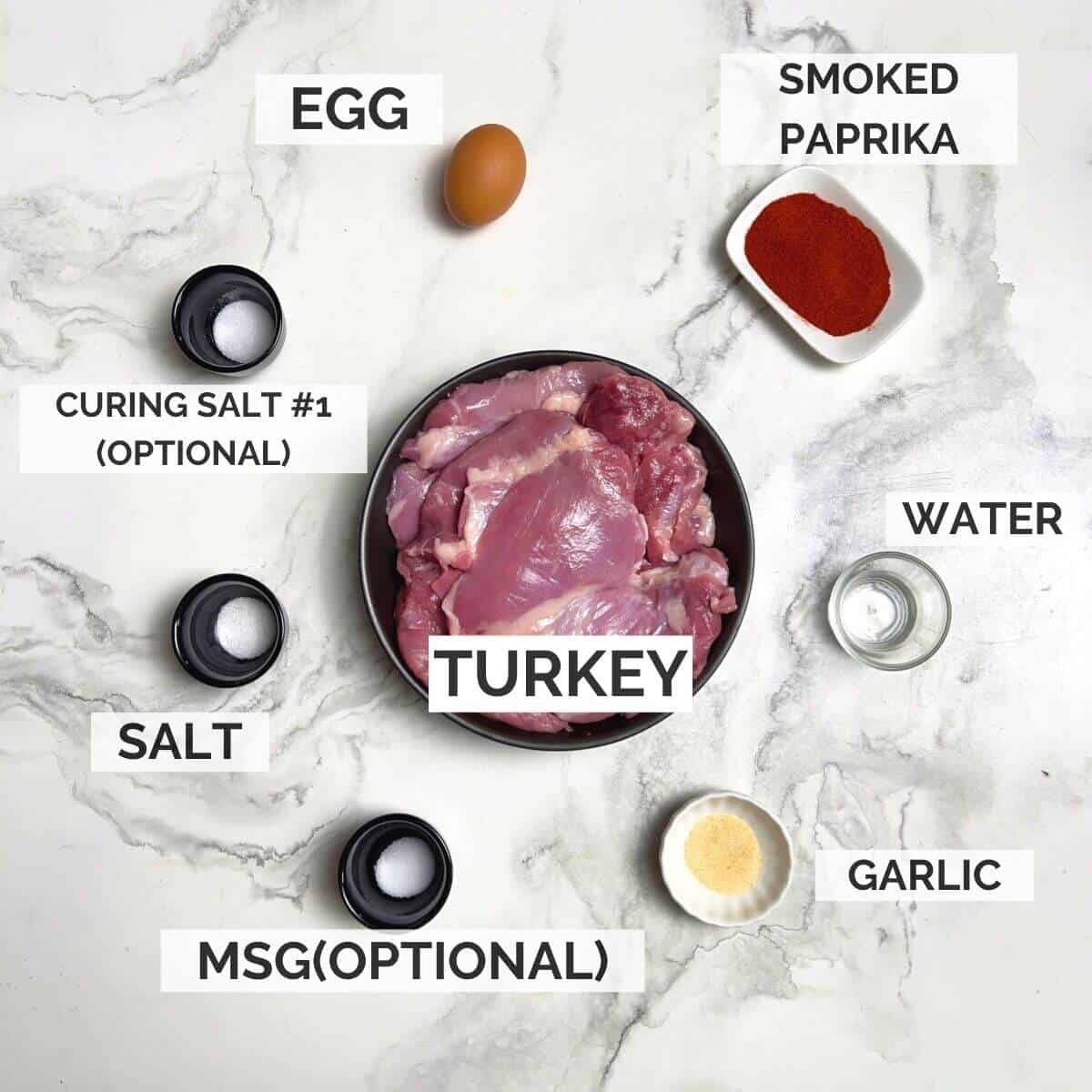
- Turkey - For my turkey deli meat recipe, I use deboned, skinless turkey thighs. You can also use turkey breast or a mix of the two. The main reason I like the thigh is because of the richer flavor. It also has a little bit of fat, which I like in my deli meats.
- Egg - We only use egg white. To be honest, this is also an optional ingredient, but I like using it for that extra protein stability when slicing it.
- Garlic - I use dried garlic, but you can use fresh minced garlic too.
- Water - Plain drinkable water. If you have it, use turkey, chicken, or vegetable stock instead. If not, the amount needed is very small, so it won't make much of a difference in flavor.
- Salt - In my opinion, a must, but you can use alternatives if your diet requires low sodium.
- MSG (optional) - Monosodium Glutamate, as we know it nowadays, is not a harmful additive but rather the 5th flavor, umami. It's naturally found in foods like tomatoes, cheese, soy, meat, fish, and fermented products. In my opinion a must in this recipe, but if you're categorically against it then just leave it out.
- Curing salt (optional) - I use curing salt number 1. Also sold as Prague powder #1, Insta Cure #1, and Pink curing salt #1. It's colored pink to prevent confusing it with table salt. Made of 94% salt and 6% sodium nitrite. It serves two functions. Firstly, to prevent botulism poisoning and secondly to give the ham that attractive pink color. In tiny amounts, like used in this recipe, it's perfectly safe, desirable, and preferred to not using it at all. Again, the choice is yours to use it or not.
- Smoked paprika (optional) - I use smoked paprika so everyone can make something as close to turkey deli ham as possible, with a smoky flavor. It also warms up the color if you choose to skip the curing salt. It's, of course, optional, and you can simply omit it if you want.
Instructions
Preparing
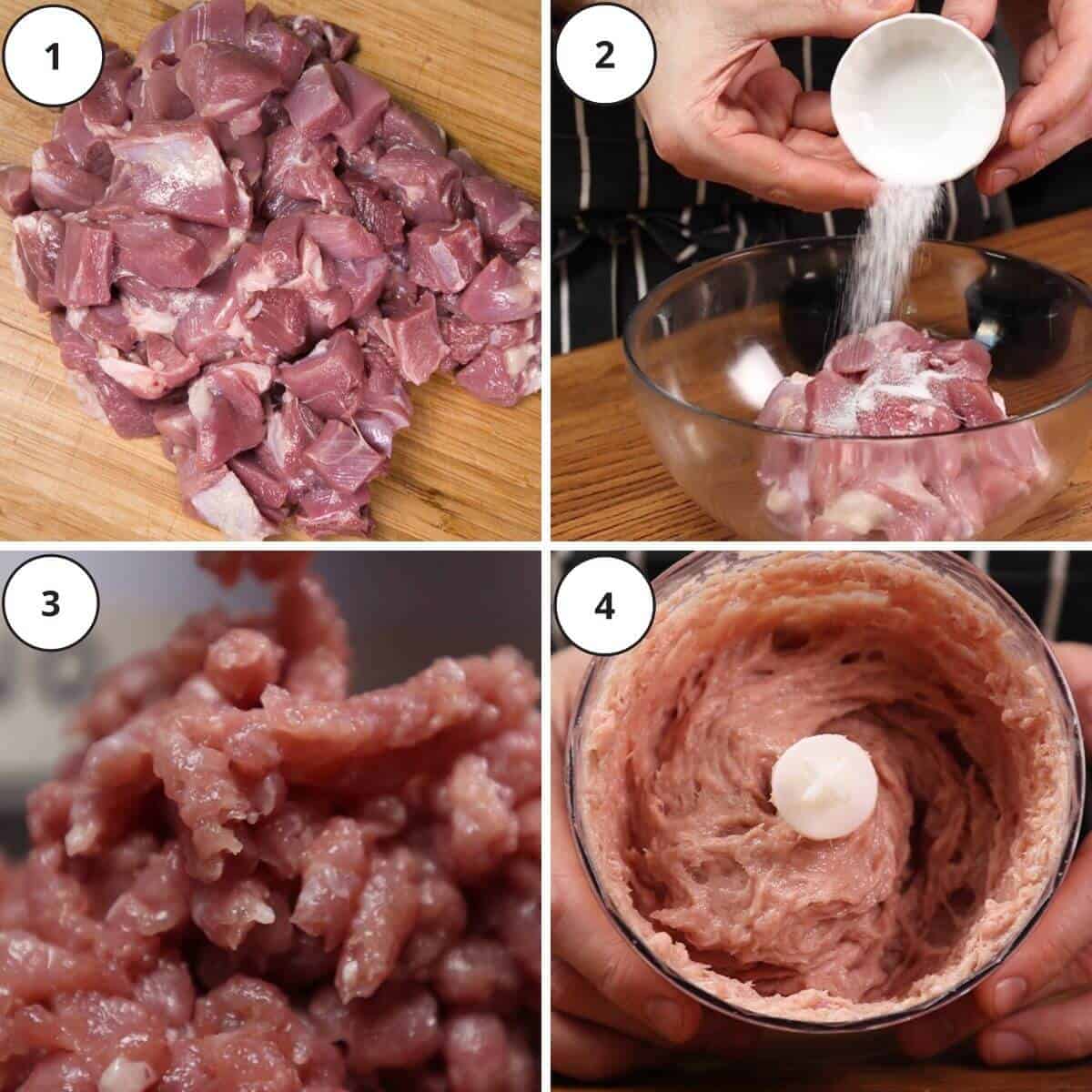
- Trim the turkey, removing any tough tissue or bones. Cut it into 2.5 cm (1 inch) cubes.
- Divide the cubes into three parts for different textures. Each part gets seasoned and prepared differently to create a specific texture. The ratios are all in the recipe card.
- Mince part of the turkey through a meat grinder using the coarse grinding plate.
- Purée part of the turkey in a food processor until smooth.
If you don't have a meat grinder or blender, use pre-made turkey mince.
Shaping
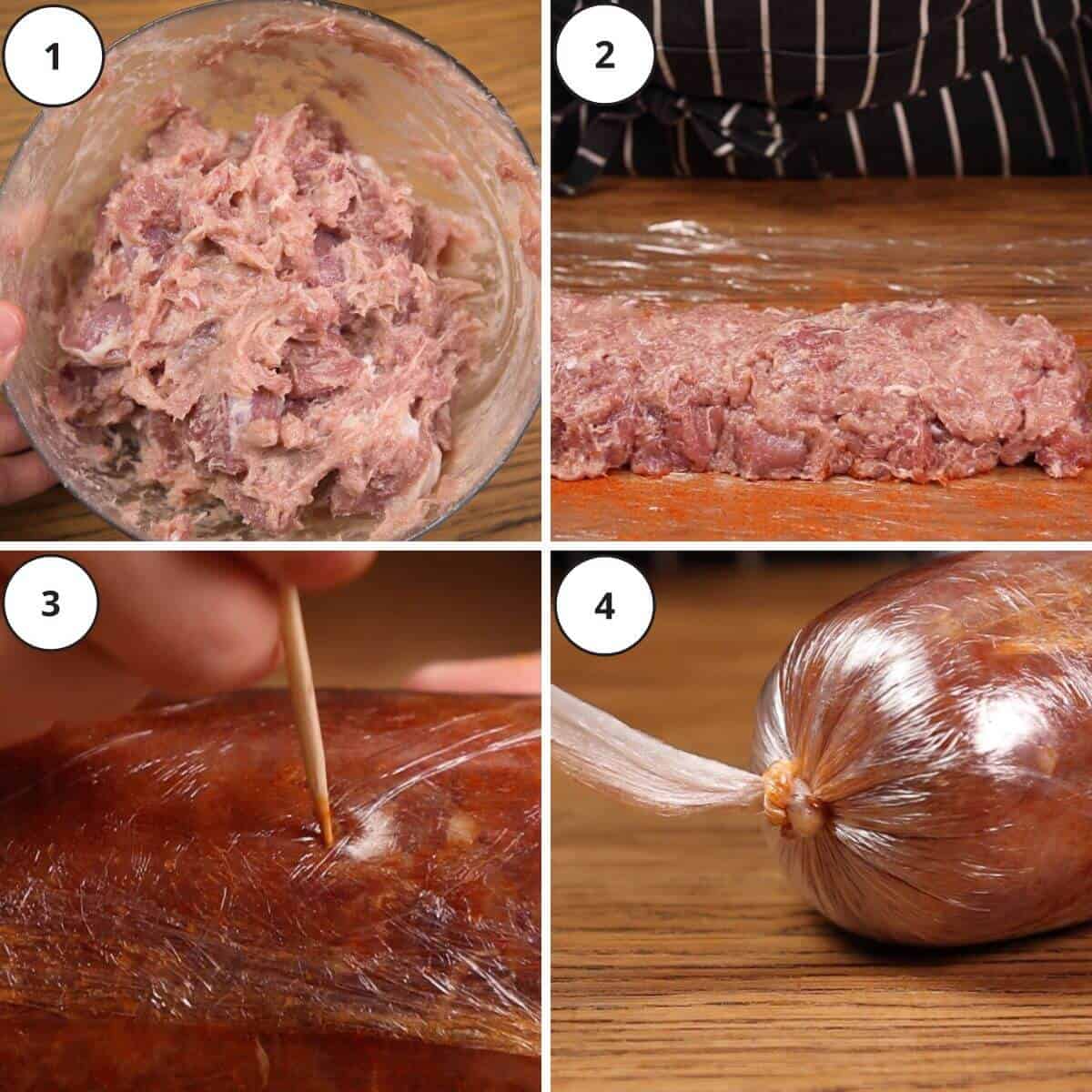
- Mix the three turkey preparations together into a homogeneous mixture.
- If you want a classic log of baloney, shape the mixture into a sausage using a sausage casing or plastic wrap sprinkled with smoked paprika. If you are not bothered about a log or sausage shape like classic Bologna, then you can simply place it into a vacuum bag or press it into a baking dish.
- Remove any trapped air by pricking holes in the wrap with a needle or toothpick.
- Wrap it tight and close the ends with a knot.
Cooking
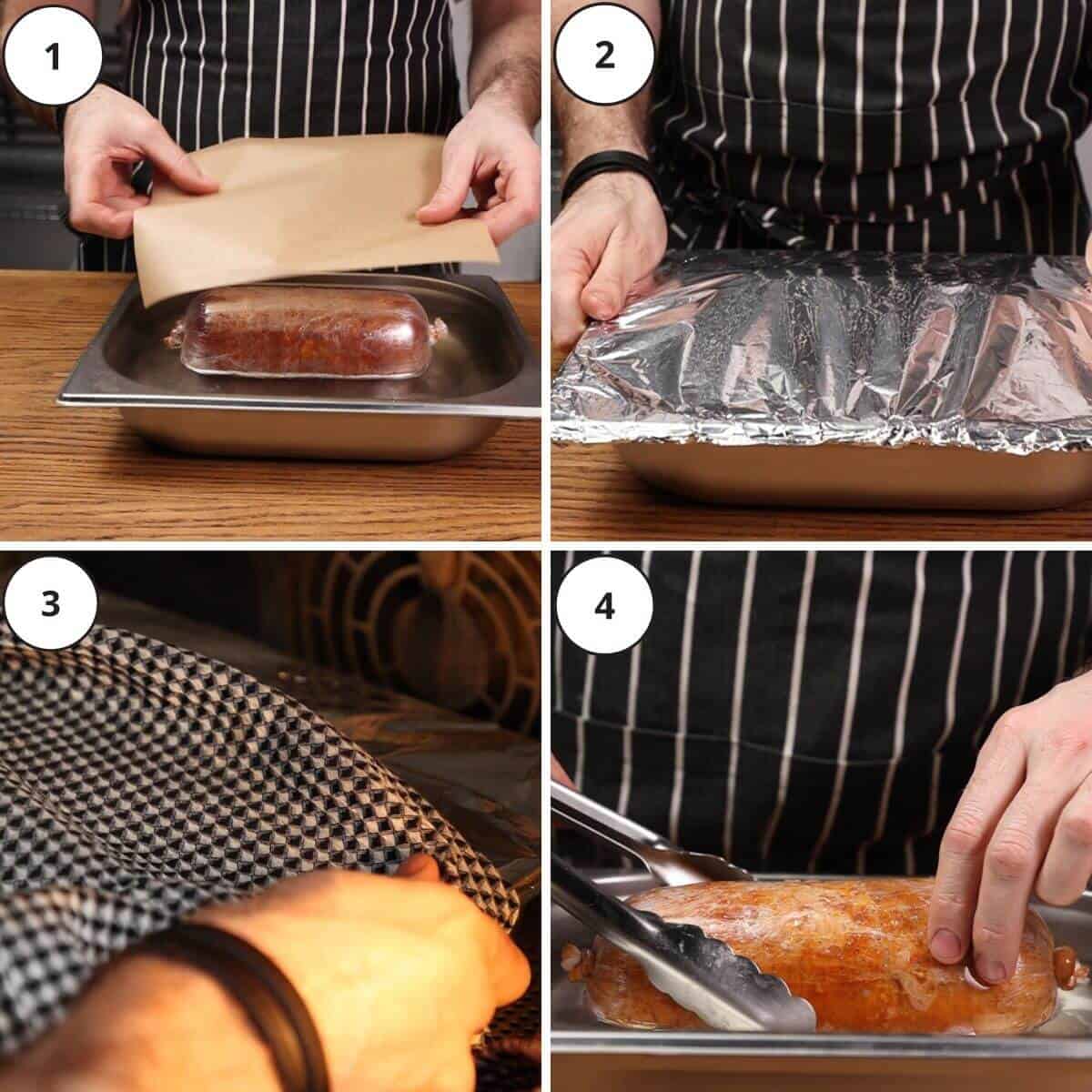
- The easiest way to cook your deli meat at home is in the oven. Preheat the oven to 100 °C (212 °F) and fill a tray with boiling water.
- Place a layer of parchment on the ham and close it tightly with foil.
- Place the ham in the oven and cook for about 60 minutes, or until the internal temperature reaches 68 °C (154 °F).
- Remove the ham from the oven and cool it down in a bowl of ice water or a cool place until the internal temperature reaches 8 °C (46 °F).
If you have a sous vide water bath, set the temperature to 70 °C (158°F).
The reason you remove the oven version at a lower temperature is that it will keep cooking due to residual heat.
See below for storage and serving instructions. All amounts and ratios are in the recipe card.
Video
Tips for success
- Meat quality - Use fresh, high-quality turkey from reputable sources. This way, you can have a high level of confidence that the turkey has been stored correctly and does not contain harmful elements.
- Use metric measurements for accuracy - It's the only accurate measuring system known to humans and is used by every single professional. It will save you many disappointments from using cheap scales to weigh your ingredients.
- Temperature control - Keep the meat and equipment cold during the process to prevent spoilage or bacterial growth. If it heats up too much, simply place it in the fridge or freezer for a bit. Even though we will cook it, it's still best practice to keep the turkey chilled throughout the process.
- Air removal - Remove large air bubbles to ensure even cooking and prevent the ham from falling apart when slicing.
- Cooking method - In my kitchens, we use different methods depending on the resources available to us. The most precise method is, of course, using a sous vide water bath. But a great home alternative is simply in the oven, like I've explained and shown in the video.
- Internal meat temperature - The single best, cheapest investment you can make is a temperature probe. All my chefs use it to cook everything from bread, carrot cake, to perfect salmon and steak. The one I use in this recipe has a long, heat-safe cable that you can insert into the oven to monitor the ham's internal temperature as it cooks. You can even set an alarm to tell you when it reaches the correct internal temperature. For safety reasons, I recommend cooking it to 68 °C (154 °F). Salmonella, the scary poultry bacteria, gets killed at 60 °C (140 °F).
- Cooling - Chill the turkey ham before slicing to ensure it holds together and retains moisture.
Troubleshooting turkey deli ham
The log fell apart when you sliced it - This is the most common failure, and it almost always traces back to one of two things: not enough purée in the mix, or trapped air. The purée is what emulsifies and binds the whole log, so if you leaned too heavy on whole cubes and mince, there is nothing holding it together. Trapped air leaves voids that become fault lines under the knife. Next time, keep the three-texture ratio as written and work the air out properly during shaping - prick the bubbles, then roll tight twice.
The meat won't come out of the ham press - Oil is the usual culprit. A thin film of oil is not enough to release a cooked protein that has bound to the metal. Use a cooking spray instead, applied generously, or line the press with plastic wrap or a vacuum-sealer bag before packing the meat in. Several readers cook the log inside vacuum-sealer plastic specifically to keep the press clean and guarantee an easy release.
You're worried the plastic wrap is unsafe to cook in - At the gentle temperature this recipe uses (the oven sits at 100°C / 212°F and the meat finishes at 68°C / 154°F), food-grade plastic wrap is safe and standard for this kind of preparation. If you would rather not use it, press the mix into a loaf tin or a tight-fitting pan instead - but it has to be packed tight, or the log will not hold together when sliced.
The texture came out rubbery or paste-like - This is the opposite of the crumbly failure: too much purée, or over-processing. If the whole mix goes through the food processor, you lose the bite that the whole cubes and coarse mince provide, and you end up with something closer to a hot dog than a deli cold cut. Keep the three parts separate and process only the portion the recipe calls for.
The color came out grey instead of pink - Cooked turkey without curing salt goes a natural pale grey-brown. There is nothing wrong with it, and it tastes the same, but it does not have the deli-counter pink most people expect. You have two ways to fix it. The first is the small amount of curing salt (Prague powder #1) the recipe lists as optional, which gives a true cured-meat pink. The second, if you would rather skip the nitrite entirely, is to work extra smoked paprika into the meat mix - it will not give the exact cured pink, but it warms the color up enough that the log reads as deli meat rather than grey.
Substitutes and variations
- Protein - Turkey thigh is the default for its richer flavor and slight fat content, but turkey breast, chicken, pork, beef, or even shrimp all work. Chicken thigh is the closest swap in terms of texture and moisture. Leaner proteins like breast benefit from keeping the egg white in to help bind.
- Spice and aromatics - The base recipe is deliberately clean, so the turkey reads as deli meat, but it takes additions well. Stir in madras curry powder or Thai curry paste for a flavored cold cut, or keep it classic with onion powder, dried herbs, or cracked black pepper.
- Inclusions - This is where you turn deli meat into mortadella. Pistachios are the traditional Italian addition. Sun-dried tomatoes, olives, capers, and chopped fresh herbs all work - fold them into the mix after the three textures are combined so they stay whole.
- Curing salt - Optional. It gives the pink deli color and protects against botulism if cold-smoking. Leave it out for an oven batch eaten within a few days, or use Prague powder #1 in the quantity listed. There is no flavor penalty either way.
- MSG - Optional but recommended for savory depth. Leave it out if you prefer, and accept a slightly flatter result. A splash of soy sauce or a little grated parmesan in the mix gets partway there by adding natural glutamates.
- Smoking - Cold-smoke the finished log if you have the setup. Use the curing salt if you smoke, to keep it safe at low smoking temperatures. For a shortcut smoky note without the equipment, the smoked paprika in the base recipe already does some of that work.
Serving suggestions
Homemade deli ham makes an amazing cold cut, great for simply having with scrambled eggs for breakfast or a few slices when you're feeling peckish. But it can be so much more.
- Sandwich - I love having it on toasted sourdough or borodinsky bread with Dijon mustard, or with a smear of pistachio pesto, homemade Caesar dressing, or lemon mayo.
- Charcuterie board - Sliced thin alongside other homemade cured meats like beef bresaola, good mustard, and pickles.
- Salad - Sliced or cubed in a Cobb salad or a simple tomato and mozzarella salad.
- Snacks - If you just want a few very simple party snacks. Dress some enoki mushrooms in soy sauce, then roll them up in a thin slice of ham.
Storage options
- Fridge - Stored airtight, homemade turkey deli meat keeps for 4 to 5 days. Using the optional curing salt extends this slightly. Keep the log whole and slice as you go rather than slicing it all at once, since exposed sliced surfaces dry out and lose color faster than a sealed log.
- Vacuum-sealed - Fully vacuum-sealed and refrigerated, it holds for up to two weeks. Portioning into smaller sealed packs means you open only what you need, and the rest stays sealed and fresh.
- Freezing - It freezes very well for up to three months with no real loss of texture. Portion it first, wrap each piece tightly, and freeze in sealed bags. Defrost overnight in the fridge - never under warm water or in the microwave, both of which seize the proteins and ruin the slice.
- Slicing for storage - If you plan to freeze it sliced for quick sandwiches, layer a small piece of parchment between slices before sealing, so they pull apart easily straight from frozen.
- How to tell if it has turned - Trust your nose. A sour or ammonia smell, a slimy surface, or any off color beyond the natural grey means it has gone and should be thrown out. Homemade deli meat without curing salt is more perishable than the commercial kind, so do not push it past the windows above.
- Food safety - Do not leave it at room temperature for extended periods. Like any cooked meat, it spoils if left out, and the no-nitrite version is less forgiving than store-bought.
Frequently asked questions
Homemade deli meat is less processed and healthier than commercially produced deli meats. All deli meats go through some sort of preparation or cooking process. Even a simple turkey breast cold cut needs to be brined and spiced before being cooked. By making your own homemade deli ham, you have full control of what goes into the mix and what texture it will be when cooked. Commercially produced deli meats contain many additives, unwanted ingredients, and preservatives.
It's healthier than commercial turkey Bologna/boloney or lunch meat, for a fact. It's also a great, clean source of protein and, eaten in normal quantities, makes it a nutritious food choice.
You can keep it in the fridge for 4 to 5 days, stored airtight. If fully vacuum sealed, up to two weeks. It also lasts longer if you use curing salt.
If you have a meat slicer, it's the best way to get those paper-thin slices you see on restaurant-style sandwiches. Otherwise, a sharp knife will do.
Yes, I make big batches and then freeze it until needed. Defrost the ham in the fridge overnight. Avoid using the microwave or running it under warm water.
I have a Frenchie, and I don't give him any. Avoid feeding deli ham to dogs because of its high salt content. If you make it without the added curing salt and use a salt alternative, I'm sure your pup will love it.
Stored airtight, 4 to 5 days. Vacuum-sealed, up to two weeks. The optional curing salt extends it slightly. Without curing salt, it is more perishable, so keep to these windows.
Not the exact cured pink, no - that color comes from the nitrite in curing salt. But working extra smoked paprika into the mix warms the color up enough that it reads as deli meat rather than grey, with no nitrite at all.
Useful equipment

Meat grinder

Temperature Probe
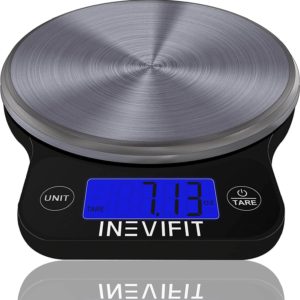
Electronic Kitchen Scales

Food processor
Related recipes

If you found this post helpful or have learned something, please comment, subscribe, and follow me on social media for more delicious recipes.
Recipe
Homemade Turkey Deli Ham
Ingredients
For the turkey cubes
- 400 grams turkey meat - skinless and boneless thigh
- 4 grams salt
- 1 gram curing salt #1 - optional
- 6 grams msg - optional
For the turkey mince
- 350 grams turkey meat
- 4 grams salt
- 1 gram curing salt #1 - optional
- 40 grams water
- 2 msg msg - optional
For the turkey puree
- 250 grams turkey meat
- 20 grams water
- 2 grams garlic powder
- 4 grams salt
- 2 gram curing salt #1 - optional
- 6 grams msg - optional
- 30 grams egg white - from one large egg
Extra
- 2 grams smoked paprika

Instructions
Preparing the meat
- Trim the turkey if not trimmed already. Remove any tough tissue or bones. Cut it into roughly 2.5 centimetre or 1 inch cubes.
- Split the cubes into three separate parts. 400 grams, 350 grams and 250 grams. Each part is seasoned differently and creates a different texture in the ham. We keep 400 grams whole, 350 grams get minced and 250 grams gets puréed.
- Season each mix as listed in the ingredients.
- Process the purée through a food processor and the mince through a mincer or buy ready made mince. Keep the 400 gram part whole.
- Mix it all together in a bowl until well combined.
Shaping (See notes for alternative shaping methods)
- Lay down a double layer of plastic wrap and sprinkle it with paprika in the centre.
- Place the turkey mix onto the paprika and wet your hands with a bit of water to prevent sticking. Shape it into a log or sausage shape, removing any trapped air pockets as well as you can.
- Fold the wrap over, so the meat is encased inside. Make sure to overlap the plastic wrap, but don't get it caught up in the meat. Push the meat from side to side through the wrap to remove more trapped air.
- Next, grab the sides and while keeping contact with the surface you roll the log tight, so it firms up. The roll will get a bit thicker and shorter.
- Use a tooth pick or needle to prick holes where you see air bubbles. Repeat the rolling and tightening process once more before wrapping in another double layer of plastic.
- Roll the ham log tight and close off the ends by tying a knot each side.
Cooking (See notes for alternative cooking method)
- Turn your oven to 100 °C or 212 °F.
- Fill up a casserole dish or deep dish with boiling water.
- Place the turkey boloney log into it. Cover with a small piece of parchment and then with foil or a tight-fitting lid.
- Cook for about an hour, or until a thermometer placed in the thickest part (centre) reaches 68 °C or 154 °F.
- Once cooked, you remove it and cool it down in a bowl of ice water or any place cool until the internal temperature reaches 8 °C or 46 °F before either storing or slicing.
Video
Notes
- Log falls apart when sliced: too little purée or trapped air. Keep the three-texture ratio and work the air out - prick bubbles, roll tight twice.
- Rubbery or paste-like: too much purée or over-processing. Keep the three parts separate.
- Grey instead of pink: use the optional curing salt, or warm the color with extra smoked paprika.
Nutrition
This recipe, and 109 others.
Everything I actually cook, organized in one book, with the exclusives that never made the blog and an online edition that behaves with flour on your hands. No ads. $19.99, yours for life.
Get the cookbook →This site contains affiliate links. I may earn a tiny commission on qualifying purchases at no extra cost to you. By bookmarking these links you help support the upkeep of this site.

Christian says
Can I add the chicken skin though for extra moisture and flavour? Or there are reasons why you dont add skins to the deli ham?
Charlé Visser says
Sure mince them up into the mix.
Diana says
how get cooked meat out of meat press cooker? Both times I've had to dig it out. Both times I oiled the pot. Thank you in advance for your help.
Charlé Visser says
Try cooking spray instead of oil.
Fay says
I have plastic for my vaccum sealer. They can be used to cook with. I plan to use in my ham press to keep it clean,
Recep EVYAPAN says
merhabalar ,bu jambonu komple tavuk eti ile yapabilirmiyim.teşekkürler.
Charlé Visser says
Yes you can use chicken meat.
Aliyah Woods says
I absolutely love this recipe and enjoyed watching you make it on the video! I will be making it this weekend. I checked the notes and there was no alternative cooking methods for this recipe. What is the cooking time and temperature to complete this recipe for a sous vide cooking method? Thank you!
Charlé Visser says
Sous vide at 70C for two hours.
Anonymous says
Thank You! I wish I could drop a picture because I’m cooking it now to your specifications. Will be back with my outcome.
gary says
Had a question on the cure #1, why do you go over the amount of 0.25% on the total amount of protein..Thanks for a reply
Charlé Visser says
I find it works best for even distribution with this mix of chunks and mince at 0.4% without overdoing it.
Anonymous says
Does water get thru the plastic wrap when cooking? It doesn’t seem like it wouldn’t.
Charlé Visser says
No. And it shouldn’t.
Mary says
Wow! Just wow! Made this today for the first time, but won’t be the last for sure. Followed the directions exactly (almost — used 2 parts Turkey breast to 1 part thighs — next time will reverse that) and it turned out great. Next time might use a tad more salt and a drop or two of liquid smoke. Future versions will include pistachios, or olives and capers.
Samantha says
Can I put this in a ham press?
Charlé Visser says
Sure thing!
Dayana says
Chef can I add any sweet(honey, brown sugar, maple etc…)???
Charlé Visser says
Yes sure Add a bit of dijon mustard while you at it.
Dayana says
Hello!! It is possible to make this but with pork? I have some pork in the fridge and Im wondering if I could use it for this recipe….????
Charlé Visser says
Sure thing! It’s great with pork!
Jack says
Must try this soon, tks.
we buy good ham for lunch snacks
one thing that’s most awesome with it is good mustard. we try to make our own mustard, sometimes good …
every person has a different way to make mustard.
Chelle says
I assume you remove the plastic wrap before cooking. Is that correct?
Charlé Visser says
No you keep it on. It's safe at the temperature we cook it at. If you are worried though, then simply cook it without but press it into a loaf tin or some sort of pan to keep the shape. It has to be tight, otherwise it will fall apart when slicing.
Peter says
This looks GOOD, Charlé!
I would like to try this smoked and then sous vide. Any advice on what type of casing would be suitable to allow smoke flavor to penetrate and also be OK to vacuum and sous vide?
Thanks man.
P.S. Love you videos.
Charlé Visser says
Hey Peter,
You better off sous vide first then smoke it. You can get fibrous casings online which you can then simply peel away once it’s smoked. Otherwise, you could skip the casings, sous vide then simply cold smoke it.
Quinn says
Is it possible to adapt this recipe using Morton tender quick instead of the Prague powder?
Charlé Visser says
The Prague powder in this recipe is for the color.
Dustin C says
For shaping, any reason you can couldn’t stuff into a large fibrous casing then smoke and/or Vaccum seal and sous vide?
Charlé Visser says
You can do it. We do and it's great.
Anonymous says
Haha!
I pretty much asked the same question. THEN your comment appeared...weird!